
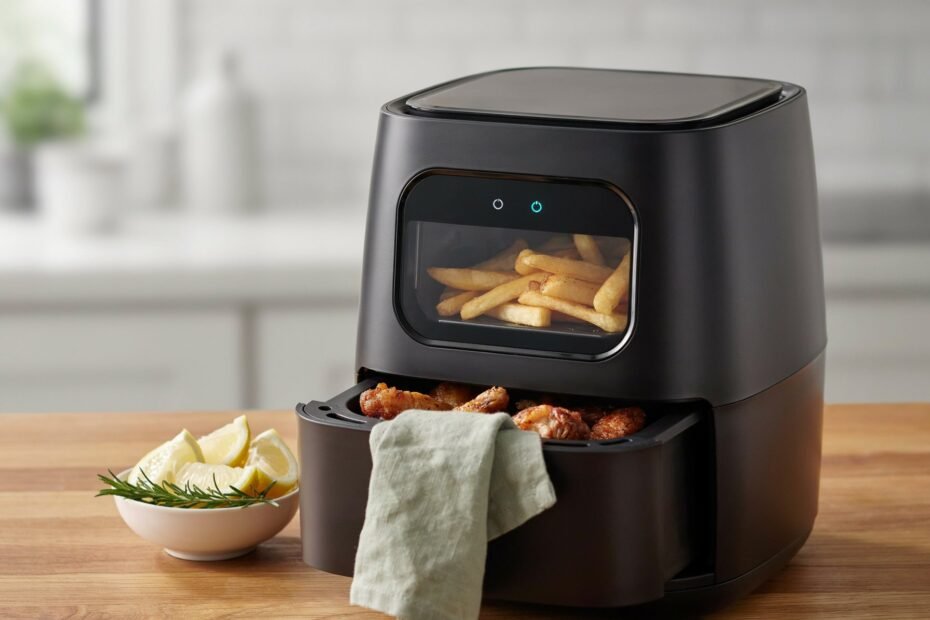
What is an air fryer? A countertop convection oven with a heating element above the food and a powerful fan that circulates air at roughly 200°C. The fast, dry air evaporates surface moisture and browns food through the Maillard reaction, giving a fried-style crunch with a teaspoon or two of oil instead of a pan full. It is also sold as an “air cooker” or “dry fryer” — they all work the same way.
Despite the name, an air fryer doesn’t fry. It’s a compact, high-powered convection oven. A heating element sits just above the food and a fan blows hot air around it at high speed. That fast, dry air dries the surface and browns it, giving the crunchy “fried” texture with a teaspoon or two of oil instead of a pan full.
The parts of an air fryer
| Part | What it does |
|---|---|
| Heating element | A coiled element (or halogen/infrared lamp in some models) at the top heats the air |
| Fan | Sits above the element and pushes hot air down and around the food |
| Basket or tray | Perforated or mesh so air reaches the food from all sides |
| Drip pan | Catches oil and crumbs under the basket |
| Thermostat and timer | Keep the set temperature and switch off when time is up |
| Safety switch | Stops the air fryer when the basket is pulled out |
| Exhaust vent | Releases hot, moist air from the back |
What happens when you cook
- Heating: the element heats the air in the small chamber to your set temperature, usually within 2–5 minutes.
- Circulation: the fan drives that hot air down, through and around the food in a continuous loop.
- Drying: fast-moving air strips away the layer of moisture on the food’s surface much quicker than still oven air.
- Browning: once the surface is dry and above about 140 °C, the Maillard reaction (between proteins and sugars) and caramelisation create the golden colour and toasty flavour we associate with frying.
- Venting: steam leaves through the exhaust, keeping the chamber dry so food crisps rather than steams.
Why it needs so little oil
In deep frying, hot oil does two jobs: it transfers heat and it dries and browns the surface. In an air fryer, hot moving air does most of that work. A light coat of oil (about 1 teaspoon per batch) still helps: it conducts heat into the surface and helps coatings like breadcrumbs and besan turn golden instead of dusty. That’s why our recipes always say to brush or spray lightly.
One tablespoon of cooking oil is roughly 120 kcal, so replacing deep frying with a teaspoon of oil makes a real difference to fat and calories. See is an air fryer healthy?
Air fryer vs convection oven vs deep fryer
| Air fryer | Convection oven | Deep fryer | |
|---|---|---|---|
| Heat source | Hot air, strong fan, small chamber | Hot air, gentler fan, large chamber | Hot oil |
| Oil used | 1 tsp–1 tbsp | Little | 1–2 litres |
| Speed | Fast | Medium | Very fast |
| Crunch | Very good | Good | Best |
More detail: air fryer vs oven and air fryer vs deep fryer cooking time.
Air fryer power, temperature and capacity at a glance
| Spec | Typical range | What it means |
|---|---|---|
| Power | 1,200–1,800 W (basket); 1,500–2,000 W (oven-style) | Higher wattage heats up and recovers faster after you open the basket. |
| Temperature | 80–200°C on most models; some reach 230°C | Enough for browning: the Maillard reaction speeds up well above 140°C. |
| Capacity | 2–8 L basket; 10–25 L oven-style | A 4–4.5 L basket suits 2–3 people; 5.5–6 L suits a family of 4. |
| Preheat time | 3–5 min | Much faster than a 10–15 min oven or OTG preheat. |
Running cost is usually low because cooking times are short — see do air fryers use a lot of electricity?
Why an air fryer browns food: the Maillard reaction
Browning is a reaction between amino acids and sugars on the surface of food. It needs a dry surface and high heat. While the surface is wet, its temperature is held near 100°C by evaporation, so nothing browns. An air fryer’s fast-moving dry air strips that moisture away quickly, letting the surface climb past 140°C, where browning and crisping speed up. That’s also why patting food dry and not overcrowding the basket make such a big difference.
Types of air fryers
- Basket air fryers: the most common; a pull-out drawer. Fastest and crispiest.
- Dual-basket air fryers: two independent drawers for cooking two foods at once.
- Oven-style air fryers: a door and shelves; bigger, and good for baking and layers. See best air fryers with shelves.
- Lid-style and combo cookers: air fry lids on pressure cookers or multi-cookers.
What this means for how you cook
- Air needs space: cook in a single layer. Crowding blocks airflow and food steams.
- Dry food crisps: pat vegetables and paneer dry.
- Wet batter drips: use thick coatings instead (see paneer pakoda).
- The top browns first: the element is close to the food, so shake or flip halfway.
Avoid the classic slip-ups in common air fryer mistakes.
Frequently asked questions
Does an air fryer actually fry food?
No. It roasts food with very hot, fast-moving air. The result looks and tastes similar to frying because the surface dries and browns.
Why does an air fryer cook faster than an oven?
The chamber is small, the heating element is close to the food and the fan is powerful, so heat reaches the food’s surface much more quickly.
Do air fryers use radiation?
Not in the microwave sense. They use a heating element and convection, like a regular electric oven. Some models use halogen or infrared lamps as the heat source.
Start cooking: beginner guides · cooking time chart